https://www.minio.org.cn/product/private-cloud-red-hat-openshifthttps://www.minio.org.cn/product/multicloud-google-kubernetes-servicehttps://www.minio.org.cn/product/multicloud-azure-kubernetes-servicehttps://www.minio.org.cn/product/multicloud-elastic-kubernetes-service
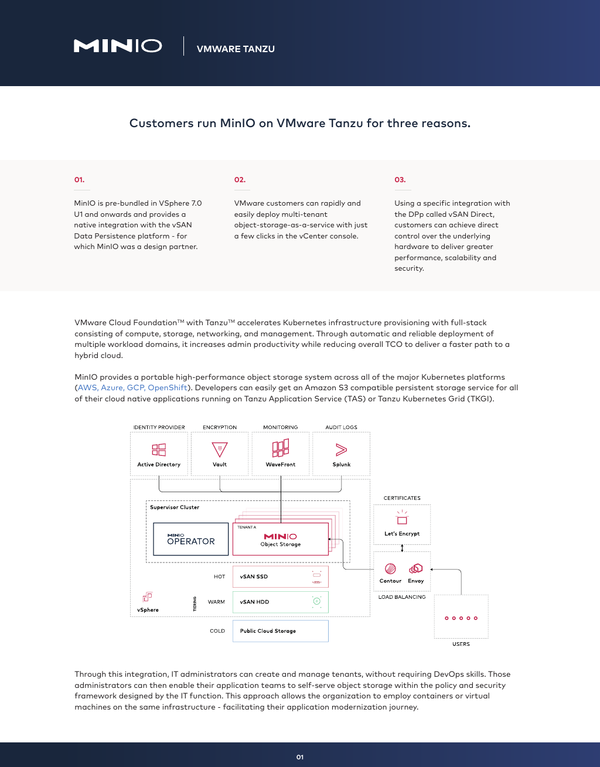
VMware Cloud Foundation TM with Tanzu TM accelerates Kubernetes infrastructure provisioning with full-stack
consisting of compute, storage, networking, and management. Through automatic and reliable deployment of
multiple workload domains, it increases admin productivity while reducing overall TCO to deliver a faster path to a
hybrid cloud.
MinIO provides a portable high-performance object storage system across all of the major Kubernetes platforms
(AWS, Azure, GCP, OpenShift). Developers can easily get an Amazon S3 compatible persistent storage service for all
of their cloud native applications running on Tanzu Application Service (TAS) or Tanzu Kubernetes Grid (TKGI).
Through this integration, IT administrators can create and manage tenants, without requiring DevOps skills. Those
administrators can then enable their application teams to self-serve object storage within the policy and security
framework designed by the IT function. This approach allows the organization to employ containers or virtual
machines on the same infrastructure - facilitating their application modernization journey.
VMWARE TANZU
Customers run MinIO on VMware Tanzu for three reasons.
MinIO is pre-bundled in VSphere 7.0
U1 and onwards and provides a
native integration with the vSAN
Data Persistence platform - for
which MinIO was a design partner.
VMware customers can rapidly and
easily deploy multi-tenant
object-storage-as-a-service with just
a few clicks in the vCenter console.
Using a specific integration with
the DPp called vSAN Direct,
customers can achieve direct
control over the underlying
hardware to deliver greater
performance, scalability and
security.
01. 02. 03.
01
VMware Cloud Foundation TM with Tanzu TM accelerates Kubernetes infrastructure provisioning with full-stack
consisting of compute, storage, networking, and management. Through automatic and reliable deployment of
multiple workload domains, it increases admin productivity while reducing overall TCO to deliver a faster path to a
hybrid cloud.
MinIO provides a portable high-performance object storage system across all of the major Kubernetes platforms
(AWS, Azure, GCP, OpenShift). Developers can easily get an Amazon S3 compatible persistent storage service for all
of their cloud native applications running on Tanzu Application Service (TAS) or Tanzu Kubernetes Grid (TKGI).
Through this integration, IT administrators can create and manage tenants, without requiring DevOps skills. Those
administrators can then enable their application teams to self-serve object storage within the policy and security
framework designed by the IT function. This approach allows the organization to employ containers or virtual
machines on the same infrastructure - facilitating their application modernization journey.
VMWARE TANZU
Customers run MinIO on VMware Tanzu for three reasons.
MinIO is pre-bundled in VSphere 7.0
U1 and onwards and provides a
native integration with the vSAN
Data Persistence platform - for
which MinIO was a design partner.
VMware customers can rapidly and
easily deploy multi-tenant
object-storage-as-a-service with just
a few clicks in the vCenter console.
Using a specific integration with
the DPp called vSAN Direct,
customers can achieve direct
control over the underlying
hardware to deliver greater
performance, scalability and
security.
01. 02. 03.
01
mailto:sales @min.iohttps://www.minio.org.cn https://blog.minio.org.cn
Encryption Key Management
Identity Management
Storage Classes and Tiering
MinIO supports all three storage vSAN
configurations: vSAN, vSAN SNA, vSAN Direct.
MinIO recommends vSAN Direct in almost all
cases as it provides direct local access to the
drives. This is the equivalent of gaining JBOD-like
access, enabling MinIO to handle distributed
erasure code, high availability, fault tolerance and
encryption.
Tiering within MinIO enables you to
cost-effectively scale storage capacity to
petabytes.
MinIO can automatically transition aged objects
from the “hot” VMware DPp tier to a
cost-efficient HDD VMware DPp tier. To optimize
for cost, tiering can be configured to use the public
clouds. For example, MinIO can be configured to
automatically transition objects from DPp tiers to
AWS S3 IA, Google Cloud Storage, or Azure Blob
Storage. MinIO protects data stored in DPp and
the public cloud using encryption.
External Load Balancing
MinIO manages TLS automatically for
applications running within Tanzu. Certificate
management and ingress are required to provide
access to applications running outside of the
Kubernetes environment.
VMware recommends using the Contour Ingress
Controller and Envoy Load Balancer extensions to
automatically distribute incoming application
traffic across multiple targets, including MinIO
tenant pods and services.
The MinIO Operator integrates completely with
the Contour and Envoy extensions to provide
automatic load balancing and routing services
across multiple MinIO Tenants. Exposing a MinIO
tenant to external traffic is done automatically as
part of tenant deployment via the vCenter
interface.
min.io sales@min.io blog.minio.io
MinIO Operator leverages VMware Tanzu features to provide:
MinIO supports using Hashicorp Vault, Amazon
KMS, Google Cloud KMS and Thales CipherTrust
(formerly Gemalto KeySecure) for Key
Management Services (KMS). These choices are
available in the vCenter interface for MinIO. MinIO
recommends Hashicorp Vault.
For all production environments we recommend
encryption to be enabled on all buckets by default.
MinIO uses AES-256-GCM or ChaCha20-Poly1305
encryption to protect data integrity and
confidentiality with negligible performance
impact.
MinIO tenants require access to the configured
KMS, whether the KMS is internal or external to
the Tanzu infrastructure. The only requirement on
the KMS is to provide access to one or more
Customer Master Keys (CMK) for use with MinIO
server-side encryption. MinIO manages
cryptographic operations using the CMK at scale
for per-object server-side encryption at high
speed. Server-side encryption can be
automatically enabled using a supported KMS
during tenant creation.
When running MinIO on Tanzu, customers can
manage single sign-on (SSO) through a third
party OpenID/LDAP compatible identity provider
like Keycloak, Okta/Auth0, Google, Facebook,
ActiveDirectory and OpenLDAP. MinIO anticipates
that most customers will use Microsoft Active
Directory identity platform. MinIO recommends
OpenID Connect (OIDC) over the LDAP protocol.
An external IDP allows administrators to centrally
manage user/application identity. MinIO builds on
top of the IDP, providing AWS IAM-style users,
groups, roles, policies and token service API. The
ability to have a unified identity and access
management (IAM) layer independent of the
infrastructure provides significant architectural
flexibility.
02
Manage identity and policy with OpenID Connect
over LDAP.
Manage encryption keys with HashiCorp Vault.
MinIO supports enabling both automatic
tenant-wide object encryption and bucket-level
encryption using SSE-S3 semantics. Clients can
also specify SSE-KMS headers to specify a
per-object CMK.
Load balance incoming requests with Contour
and Envoy.
Tier across vSAN Direct, vSAN (SSD, HDD) and
public cloud storage.
Encryption Key Management
Identity Management
Storage Classes and Tiering
MinIO supports all three storage vSAN
configurations: vSAN, vSAN SNA, vSAN Direct.
MinIO recommends vSAN Direct in almost all
cases as it provides direct local access to the
drives. This is the equivalent of gaining JBOD-like
access, enabling MinIO to handle distributed
erasure code, high availability, fault tolerance and
encryption.
Tiering within MinIO enables you to
cost-effectively scale storage capacity to
petabytes.
MinIO can automatically transition aged objects
from the “hot” VMware DPp tier to a
cost-efficient HDD VMware DPp tier. To optimize
for cost, tiering can be configured to use the public
clouds. For example, MinIO can be configured to
automatically transition objects from DPp tiers to
AWS S3 IA, Google Cloud Storage, or Azure Blob
Storage. MinIO protects data stored in DPp and
the public cloud using encryption.
External Load Balancing
MinIO manages TLS automatically for
applications running within Tanzu. Certificate
management and ingress are required to provide
access to applications running outside of the
Kubernetes environment.
VMware recommends using the Contour Ingress
Controller and Envoy Load Balancer extensions to
automatically distribute incoming application
traffic across multiple targets, including MinIO
tenant pods and services.
The MinIO Operator integrates completely with
the Contour and Envoy extensions to provide
automatic load balancing and routing services
across multiple MinIO Tenants. Exposing a MinIO
tenant to external traffic is done automatically as
part of tenant deployment via the vCenter
interface.
min.io sales@min.io blog.minio.io
MinIO Operator leverages VMware Tanzu features to provide:
MinIO supports using Hashicorp Vault, Amazon
KMS, Google Cloud KMS and Thales CipherTrust
(formerly Gemalto KeySecure) for Key
Management Services (KMS). These choices are
available in the vCenter interface for MinIO. MinIO
recommends Hashicorp Vault.
For all production environments we recommend
encryption to be enabled on all buckets by default.
MinIO uses AES-256-GCM or ChaCha20-Poly1305
encryption to protect data integrity and
confidentiality with negligible performance
impact.
MinIO tenants require access to the configured
KMS, whether the KMS is internal or external to
the Tanzu infrastructure. The only requirement on
the KMS is to provide access to one or more
Customer Master Keys (CMK) for use with MinIO
server-side encryption. MinIO manages
cryptographic operations using the CMK at scale
for per-object server-side encryption at high
speed. Server-side encryption can be
automatically enabled using a supported KMS
during tenant creation.
When running MinIO on Tanzu, customers can
manage single sign-on (SSO) through a third
party OpenID/LDAP compatible identity provider
like Keycloak, Okta/Auth0, Google, Facebook,
ActiveDirectory and OpenLDAP. MinIO anticipates
that most customers will use Microsoft Active
Directory identity platform. MinIO recommends
OpenID Connect (OIDC) over the LDAP protocol.
An external IDP allows administrators to centrally
manage user/application identity. MinIO builds on
top of the IDP, providing AWS IAM-style users,
groups, roles, policies and token service API. The
ability to have a unified identity and access
management (IAM) layer independent of the
infrastructure provides significant architectural
flexibility.
02
Manage identity and policy with OpenID Connect
over LDAP.
Manage encryption keys with HashiCorp Vault.
MinIO supports enabling both automatic
tenant-wide object encryption and bucket-level
encryption using SSE-S3 semantics. Clients can
also specify SSE-KMS headers to specify a
per-object CMK.
Load balance incoming requests with Contour
and Envoy.
Tier across vSAN Direct, vSAN (SSD, HDD) and
public cloud storage.
mailto:sales @min.iohttps://www.minio.org.cn https://blog.minio.org.cn
https://www.minio.org.cn https://www.minio.org.cn/download https://minio.slack.com
Enabling MinIO auditing generates a log for every
operation on the object storage cluster. In addition
to the audit log, MinIO also logs console errors for
operational troubleshooting purposes.
MinIO supports outputting logs to Splunk,
Elasticsearch and others for analysis and alerting.
Certificate Management
All traffic from the application to MinIO, including
internode traffic, is encrypted with TLS. TLS
certificates are used to secure network
communications and establish the identity of
network-connected resources, such as a MinIO
Server.
MinIO integrates with any ACME protocol
compatible Certificate Manager to configure,
provision, manage and update certificates for the
MinIO tenants. The tenants are completely
isolated from each other in their own Kubernetes
namespace with their own certificates for
improved security.
Monitoring and Alerting
MinIO recommends using Prometheus-compatible
systems for VMware Tanzu monitoring and
alerting. MinIO publishes every object storage
related Prometheus metric imaginable, from
bucket capacity to access metrics. Those metrics
can be collected and visualized in any
Prometheus-compatible tool or the MinIO Console.
External monitoring solutions scrape the MinIO
Prometheus endpoint at regular intervals. MinIO
recommends either Wavefront or Grafana
depending on architectural goals and Tanzu
observability requirements. These same tools can
also be used to establish baselines and set alert
thresholds for notifications, which can then be
routed to a notification platform such as
PagerDuty, Freshservice or even SNMP.
min.io sales@min.io blog.minio.io
Logging and Auditing
03
Configure and manage certificates with any
ACME compatible solution.
Output logs to Elasticsearch or Splunk for
analysis.
Track metrics and issue alerts using Wavefront
or Grafana.
MinIO offers the most deployment options of any object storage across hybrid, multicloud and edge environments
using Kubernetes. VMware Tanzu users can quickly and easily deploy multi-tenant MinIO object storage within
their existing environment.
The MinIO Kubernetes Operator supports end-to-end configuration and deployment of MinIO tenants, seamlessly
integrating with supporting infrastructure for storage tiering, monitoring, audit logging, identity management,
certificate management, key management for automatic server-side object encryption and load balancing and
ingress.
Learn more at min.io or try it for yourself at min.io/download. Join the conversation at minio.slack.com.
https://www.minio.org.cn https://www.minio.org.cn/download https://minio.slack.com
Enabling MinIO auditing generates a log for every
operation on the object storage cluster. In addition
to the audit log, MinIO also logs console errors for
operational troubleshooting purposes.
MinIO supports outputting logs to Splunk,
Elasticsearch and others for analysis and alerting.
Certificate Management
All traffic from the application to MinIO, including
internode traffic, is encrypted with TLS. TLS
certificates are used to secure network
communications and establish the identity of
network-connected resources, such as a MinIO
Server.
MinIO integrates with any ACME protocol
compatible Certificate Manager to configure,
provision, manage and update certificates for the
MinIO tenants. The tenants are completely
isolated from each other in their own Kubernetes
namespace with their own certificates for
improved security.
Monitoring and Alerting
MinIO recommends using Prometheus-compatible
systems for VMware Tanzu monitoring and
alerting. MinIO publishes every object storage
related Prometheus metric imaginable, from
bucket capacity to access metrics. Those metrics
can be collected and visualized in any
Prometheus-compatible tool or the MinIO Console.
External monitoring solutions scrape the MinIO
Prometheus endpoint at regular intervals. MinIO
recommends either Wavefront or Grafana
depending on architectural goals and Tanzu
observability requirements. These same tools can
also be used to establish baselines and set alert
thresholds for notifications, which can then be
routed to a notification platform such as
PagerDuty, Freshservice or even SNMP.
min.io sales@min.io blog.minio.io
Logging and Auditing
03
Configure and manage certificates with any
ACME compatible solution.
Output logs to Elasticsearch or Splunk for
analysis.
Track metrics and issue alerts using Wavefront
or Grafana.
MinIO offers the most deployment options of any object storage across hybrid, multicloud and edge environments
using Kubernetes. VMware Tanzu users can quickly and easily deploy multi-tenant MinIO object storage within
their existing environment.
The MinIO Kubernetes Operator supports end-to-end configuration and deployment of MinIO tenants, seamlessly
integrating with supporting infrastructure for storage tiering, monitoring, audit logging, identity management,
certificate management, key management for automatic server-side object encryption and load balancing and
ingress.
Learn more at min.io or try it for yourself at min.io/download. Join the conversation at minio.slack.com.